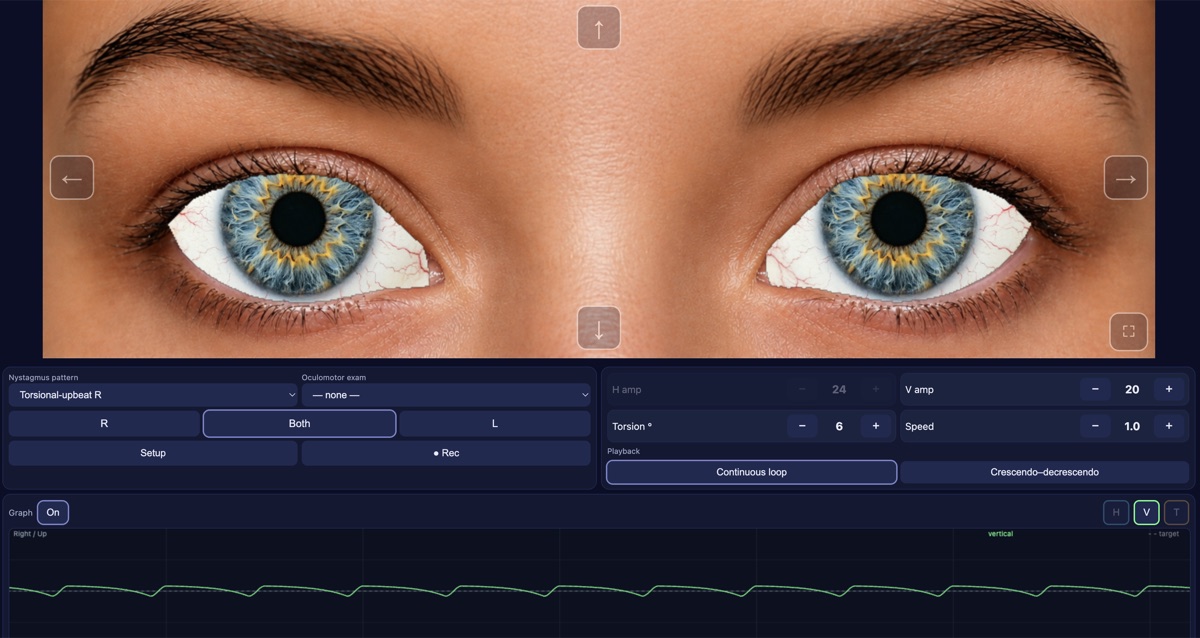
A browser-based platform for medical students, residents, and clinicians to study nystagmus patterns and practice the complete oculomotor examination — including a motion-driven head thrust test — through interactive, physiologically accurate simulations.
Realistic simulations of eye movement disorders with adjustable parameters, real-time visualization, and comprehensive oculomotor exam protocols
Ten patterns — horizontal right/left-beat, upbeat, downbeat, torsional-upbeat R/L, pendular, see-saw, square-wave jerks, and PAN — with tunable amplitude, speed, and Alexander's law, plus crescendo–decrescendo playback you repeat cycle-by-cycle.
Complete bedside protocols: smooth pursuit on an H-pattern target, hyper/hypometric saccades, skew deviation with alternating cover test, convergence with deficit modelling, lateral head thrust, and gaze-evoked nystagmus.
Live-scrolling EKG-style traces of horizontal, vertical, and torsional eye position alongside head/target traces, following clinical convention (up = patient's right/up), with per-trace toggles.
Record simulations for presentations, case studies, or educational materials. Export as MP4 or WebM directly from the browser.
Fine-tune amplitude, speed, saccade delay and jump count, skew H/V ratios, ball size, and per-view calibration — then lock each view so your setup never drifts.
Touch-optimized controls, fullscreen standalone mode, and phone motion sensors that turn your phone into the patient's head for the head thrust test. No installation required.
Practice the complete bedside oculomotor exam with physiologically accurate simulations
Drag the target along an H-shaped track (horizontal bar with vertical ends). Healthy eyes track smoothly with 1–2 tiny catch-up saccades on brief lapses.
Hypermetric (overshoot + return) and hypometric (undershoot + second jump) saccades in horizontal and vertical planes, with adjustable latency and jump count.
Alternating cover test: the covered eye rests straight; uncovering reveals the corrective jump to the inferior-medial skew position in 1–2 saccades. Skew H/V amplitudes tune live.
Slide the near target toward the nose — both eyes adduct with slight intorsion (normal). Select a convergence deficit (L/R) and that eye breaks partway, abducting back toward primary gaze.
Auto timeline on desktop, or manual mode on mobile: teeter the phone slowly (intact VOR holds gaze), then flick-and-stop to trigger the deficient thrust and corrective saccade.
Direction-fixed (always beats one way, weaker on opposite gaze) or direction-changing (beats toward gaze) nystagmus with adjustable intensity.
Designed for medical education at every stage, from classroom to bedside
Learn to recognize different nystagmus patterns and understand the oculomotor examination before seeing real patients.
Refine your examination technique and learn to differentiate subtle findings in neurology and ophthalmology rotations.
Demonstrate findings to patients, create teaching materials, or refresh your knowledge of specific eye movement disorders.
Enhance your teaching with interactive demonstrations. Show students exactly what to look for during the exam.
Built with modern web standards for maximum accessibility and ease of use. No downloads, no installations, no accounts required.
Simply open the app in any modern browser and start learning. Your work is saved locally, and you can export recordings for presentations or documentation.
Start exploring nystagmus patterns and oculomotor examination techniques today